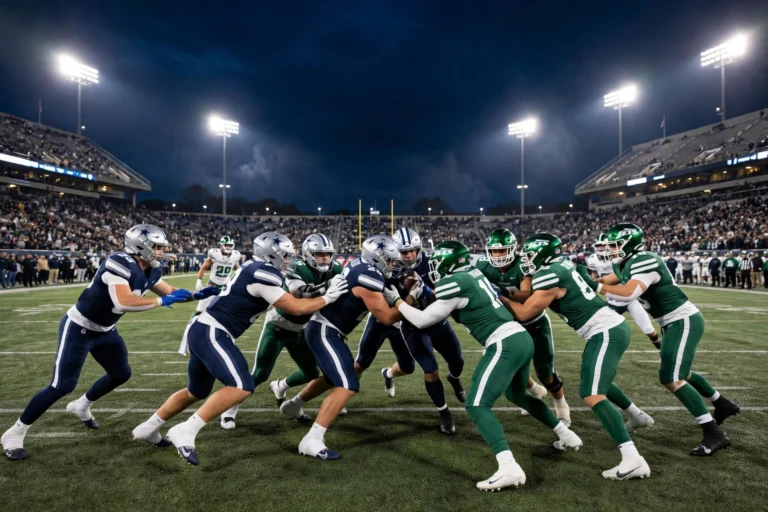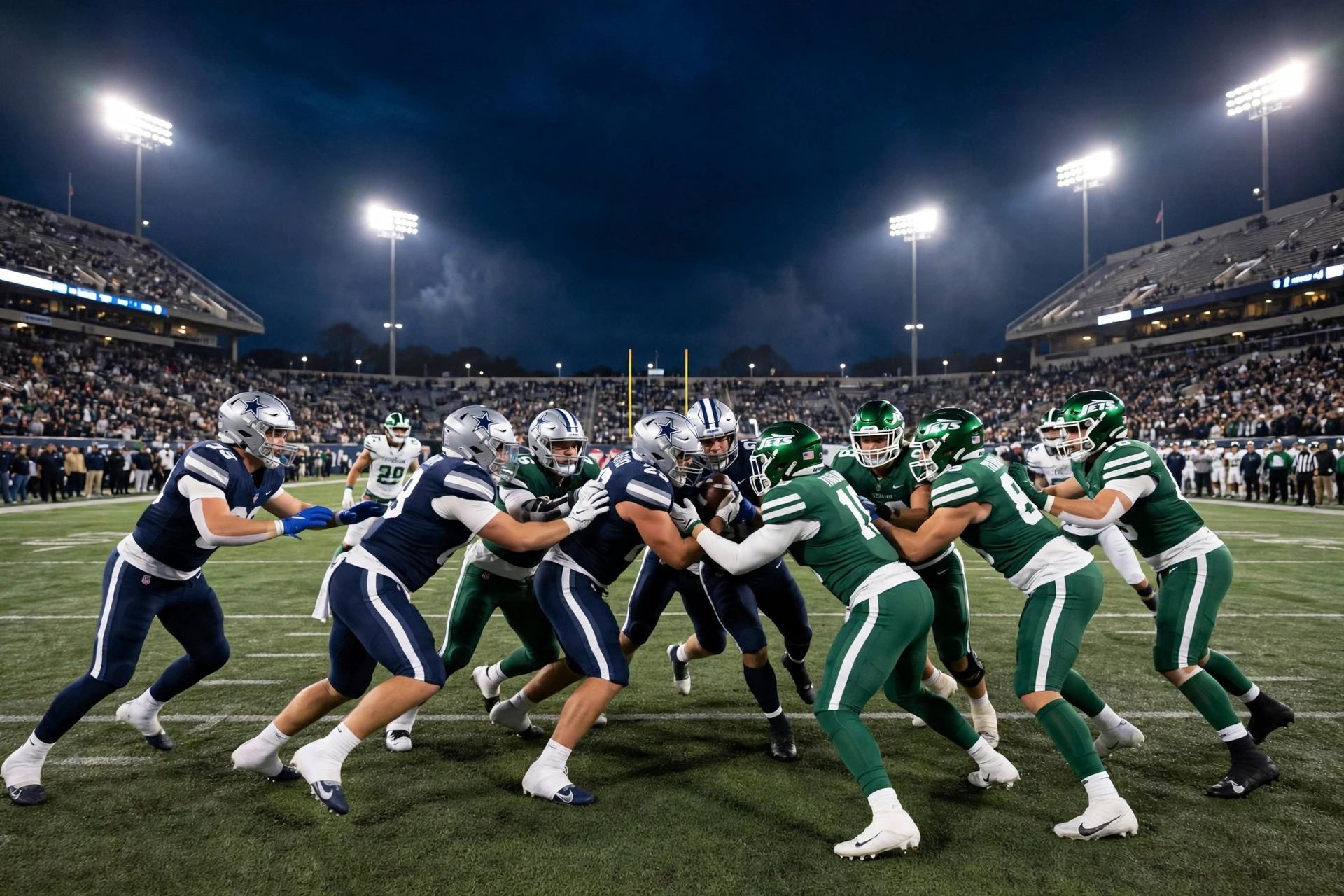
The dallas cowboys vs new york jets match player stats provide an interesting look at how individual performances, offensive execution, and defensive pressure can determine the outcome of an NFL matchup. The Dallas Cowboys and New York Jets have different playing styles, making their meetings particularly interesting for football fans who enjoy analyzing quarterback performances, rushing production, receiving yards, and defensive contributions.
Their most recent regular-season meeting took place on October 5, 2025, at MetLife Stadium in East Rutherford, New Jersey. The Dallas Cowboys defeated the New York Jets 37–22 in a Week 5 contest. Dallas produced an impressive offensive performance, led by quarterback Dak Prescott and running back Javonte Williams.
The game also featured notable contributions from Ryan Flournoy, Jake Ferguson, George Pickens, Justin Fields, and Breece Hall. Examining the individual numbers helps explain why Dallas controlled much of the contest and how New York attempted to respond.

Dallas Cowboys vs New York Jets: Match Overview
The October 5, 2025 matchup provided plenty of statistical talking points. Dallas entered the contest looking to overcome injuries and improve its position during the early part of the season. New York wanted to secure its first victory but struggled to contain the Cowboys’ offensive attack.
Read the official game recap for more details on the game.
WEEK 5 · OCTOBER 5, 2025 · METLIFE STADIUM
Result: Dallas Cowboys 37 points; New York Jets 22 points
Winning team: Dallas Cowboys
Losing team: New York Jets
Stadium: MetLife Stadium
Competition: NFL regular season
Dallas established control through efficient passing, explosive rushing plays, and successful red-zone execution. New York generated considerable offensive yardage but struggled to turn enough of its opportunities into points.
Dallas Cowboys vs New York Jets Match Player Stats: Quarterback Performance
Quarterback statistics are among the most important elements when evaluating an NFL game. Completion percentage, passing yards, touchdowns, interceptions, and decision-making help explain how effectively each offense operated.
Dak Prescott’s impressive performance
Dak Prescott delivered one of the strongest individual performances of the game.
Completions: 18
Pass attempts: 29
Passing yards: 237
Passing touchdowns: 4
Interceptions: 0
Passer rating: 127.4
Prescott completed 18 of his 29 attempts and recorded four passing touchdowns without throwing an interception. His ability to distribute the football effectively helped Dallas maintain offensive momentum.
One particularly important aspect of his performance was his connection with multiple receiving targets. Rather than depending on a single player, Prescott spread the ball around and created opportunities for different members of the offense.
His four touchdown passes demonstrated his effectiveness in scoring situations and helped Dallas build a substantial advantage.
Justin Fields’ performance for the Jets
Justin Fields produced a productive passing performance despite the defeat.
Completions: 32
Pass attempts: 51
Passing yards: 283
Passing touchdowns: 2
Interceptions: 0
Sacks taken: 5
Fields recorded 283 passing yards and two touchdowns. His passing production helped New York remain competitive statistically, particularly during the later stages of the game.
However, Dallas applied considerable pressure throughout the contest. The Cowboys recorded five sacks, making it difficult for Fields to establish consistent offensive rhythm.
Although his passing yardage exceeded Prescott’s total, the difference in touchdown production played an important role in determining the final result.
Rushing Statistics: Cowboys vs Jets
The ground game was another major difference between the two teams. Dallas used its running backs effectively, creating opportunities for longer gains and helping the offense maintain control.
Javonte Williams leads the Cowboys
Javonte Williams was a standout performer, finishing with 135 rushing yards and one touchdown.
Carries: 16
Rushing yards: 135
Average yards per carry: 8.4
Longest run: 66 yards
Rushing touchdowns: 1
Williams consistently found opportunities to move the football downfield. His 66-yard run demonstrated his ability to turn a regular rushing attempt into an explosive offensive play.
His contribution was particularly important because Dallas had several offensive linemen unavailable. Despite those challenges, the Cowboys generated 180 total rushing yards.
Breece Hall’s contribution for New York
Breece Hall was one of the Jets’ most productive offensive players.
Carries: 14
Rushing yards: 113
Average yards per carry: 8.1
Rushing touchdowns: 0
Hall recorded more than 100 rushing yards, providing New York with a reliable source of offensive production.
His performance demonstrated that the Jets could create opportunities on the ground. However, the team struggled to convert its offensive production into enough touchdowns to challenge Dallas.
Other rushing contributions
Other players also contributed to the ground game:
- Dak Prescott recorded 28 rushing yards for Dallas.
- Ryan Flournoy added 10 rushing yards.
- Jaydon Blue contributed seven rushing yards.
- Justin Fields recorded 26 rushing yards for New York.
- Isaiah Davis added five rushing yards.
The rushing numbers show that both teams had productive individual performances, but Dallas generated more total rushing yardage and converted its opportunities more effectively.
Receiving Statistics: Key Wide Receivers and Tight Ends
Receiving statistics help explain how quarterbacks distribute the football and which players make the biggest contributions to an offense.
The dallas cowboys vs new york jets match player stats highlight several important receiving performances, particularly from Ryan Flournoy, Jake Ferguson, George Pickens, and Garrett Wilson.
Ryan Flournoy’s breakout performance
Ryan Flournoy delivered an impressive performance for Dallas.
Receptions: 6
Targets: 9
Receiving yards: 114
Average yards per reception: 19.0
Receiving touchdowns: 0
Longest reception: 46 yards
Flournoy led the Cowboys in receiving yards, recording 114 yards on six receptions. His ability to create separation and gain significant yardage after receiving the football made him an important part of the offensive strategy.
His 46-yard reception was particularly valuable because it helped Dallas create a major scoring opportunity.
Jake Ferguson’s touchdown production
Jake Ferguson was another important contributor.
Receptions: 7
Targets: 9
Receiving yards: 49
Receiving touchdowns: 2
Longest reception: 26 yards
Ferguson caught two touchdown passes, demonstrating his value as a reliable target in scoring situations.
Tight ends often play an important role in the red zone because they can provide quarterbacks with an additional passing option. Ferguson’s performance illustrated that advantage.
George Pickens adds an explosive element
George Pickens also made a significant contribution.
Receptions: 2
Targets: 4
Receiving yards: 57
Receiving touchdowns: 1
Longest reception: 43 yards
Pickens averaged 28.5 yards per reception. His 43-yard touchdown reception was one of the important scoring moments of the game.
Garrett Wilson leads the Jets’ receivers
Garrett Wilson provided a productive performance for New York.
Receptions: 6
Targets: 10
Receiving yards: 71
Receiving touchdowns: 1
Wilson was one of Fields’ primary passing targets. His six receptions helped the Jets move the football, while his touchdown contribution provided an important scoring moment.
Other notable receiving performances
New York also received contributions from several other players:
- Mason Taylor: 9 receptions for 67 yards.
- Breece Hall: 4 receptions for 42 yards.
- Josh Reynolds: 3 receptions for 29 yards.
- Jeremy Ruckert: 4 receptions for 28 yards.
- Isaiah Davis: 3 receptions for 28 yards.
- Andrew Beck: 1 reception for 1 yard and 1 touchdown.
These contributions demonstrate that the Jets distributed the football among several offensive players.
Complete Player Statistics Comparison
The following table summarizes the leading offensive performers from both teams.
See the full box score for complete statistics.
| Player | Team | Category | Stat Line |
|---|---|---|---|
| Dak Prescott | Cowboys | Passing | 237 yards, 4 TD |
| Justin Fields | Jets | Passing | 283 yards, 2 TD |
| Javonte Williams | Cowboys | Rushing | 135 yards, 1 TD |
| Breece Hall | Jets | Rushing | 113 yards |
| Ryan Flournoy | Cowboys | Receiving | 114 yards |
| Jake Ferguson | Cowboys | Receiving | 49 yards, 2 TD |
| George Pickens | Cowboys | Receiving | 57 yards, 1 TD |
| Garrett Wilson | Jets | Receiving | 71 yards, 1 TD |
| Mason Taylor | Jets | Receiving | 67 yards |
These figures demonstrate that individual statistical leaders do not always belong to the winning team. Fields recorded more passing yards than Prescott, while Hall produced an impressive rushing performance. However, Dallas benefited from better scoring efficiency and a more effective overall offensive performance.
Defensive Player Statistics and Key Contributions
Defense played an important role in the Cowboys’ victory. Dallas consistently pressured the Jets’ quarterback and made it difficult for New York to establish a comfortable passing rhythm.
Micah Parsons’ defensive impact
Micah Parsons was a major contributor to the Cowboys’ defensive performance.
His statistical contributions included:
- Two quarterback sacks.
- Four quarterback hits.
- Three tackles for loss.
- One forced fumble.
- One fumble recovery.
- Nine quarterback pressures.
Parsons demonstrated his ability to influence the game through pressure, physical play, and disruptive defensive positioning.
His performance was particularly important because New York needed time to develop its passing plays. Consistent pressure reduced the opportunities available to Fields and forced the Jets to adjust their offensive approach.
Shemar James leads in tackles
Shemar James led Dallas with 15 tackles.
His contribution highlighted the importance of defensive consistency. Tackles help prevent offensive plays from developing into larger gains and are particularly valuable when an opponent has an effective rushing attack.
Dallas creates pressure throughout the game
The Cowboys recorded five sacks against Justin Fields. This defensive production helped limit New York’s offensive efficiency despite the Jets recording 378 total yards.
Dallas also benefited from contributions across its defensive lineup, with five players recording at least half a sack.
The dallas cowboys vs new york jets match player stats therefore reveal that defensive pressure was an important part of the result, even though the Jets managed to accumulate considerable yardage.
Team Statistics: Dallas Cowboys vs New York Jets
Individual performances become more meaningful when considered alongside overall team statistics.
Total net yards: Cowboys 416; Jets 378
Passing yards: Cowboys 237; Jets 283
Rushing yards: Cowboys 180; Jets 144
Total penalties: Cowboys 11; Jets 10
Penalty yards: Cowboys 91; Jets 61
Time of possession: Cowboys 25:24; Jets 34:36
Final score: Cowboys 37; Jets 22
One interesting detail is that New York controlled possession for more than 34 minutes, compared with approximately 25 minutes for Dallas. Nevertheless, the Cowboys generated more total yards and scored considerably more points.
Dallas also demonstrated better scoring efficiency, particularly in the red zone, where the team converted three of four opportunities.
Quarter-by-Quarter Scoring Breakdown
The scoring progression illustrates how Dallas gradually established its advantage.
First quarter: Cowboys 3; Jets 3
Second quarter: Cowboys 20; Jets 0
Third quarter: Cowboys 7; Jets 3
Fourth quarter: Cowboys 7; Jets 16
Final: Cowboys 37; Jets 22
First quarter: Both teams find the scoreboard
The Jets opened the game with a lengthy offensive drive and scored a field goal. Dallas responded with a field goal of its own, leaving the contest tied at 3–3.
Second quarter: Dallas takes control
The second quarter proved decisive. Dallas scored 20 unanswered points, using effective passing and explosive offensive plays to establish a comfortable lead.
Third quarter: Cowboys maintain their advantage
Dallas added another touchdown, while New York managed a field goal. The Cowboys continued to control the scoreboard.
Fourth quarter: Jets attempt a comeback
New York improved its offensive production during the final quarter and scored 16 points. However, the comeback attempt was insufficient to overcome Dallas’s earlier advantage.
The Cowboys added another touchdown to finish the game with a 37–22 victory.
What Made the Cowboys Successful?
Several factors contributed to Dallas’s victory.
- Efficient quarterback play — Prescott delivered four touchdown passes without an interception. His decision-making and ability to distribute the football helped Dallas maintain offensive consistency.
- Explosive rushing production — Williams averaged 8.4 yards per carry and finished with 135 rushing yards. His performance gave Dallas another effective offensive option.
- Multiple receiving threats — Flournoy, Ferguson, and Pickens all made important contributions. Their combined production prevented New York from focusing its defensive attention on just one receiver.
- Consistent defensive pressure — The Cowboys recorded five sacks and disrupted the Jets’ passing attack. Parsons was especially influential, contributing sacks, tackles for loss, and a forced fumble.
Why Did the New York Jets Lose?
Although New York produced respectable offensive numbers, several issues contributed to the defeat.
- Insufficient scoring efficiency: The Jets generated 378 total yards but scored only 22 points.
- Quarterback pressure: Five sacks affected the passing offense.
- Defensive difficulties: Dallas scored 20 points in the second quarter alone.
- Explosive offensive plays allowed: The Cowboys created several significant gains through the passing and rushing games.
- Slow response: New York’s strongest scoring period came in the fourth quarter, when Dallas already had a substantial lead.
These factors demonstrate why total yardage alone cannot determine which team performed better.
Historical Significance of the Matchup
The Cowboys and Jets are two recognizable franchises in professional American football. Their matchups attract attention because both teams have passionate fan bases and distinctive football traditions.
Dallas has traditionally been associated with high-profile offensive players, strong quarterback performances, and national attention. The Jets, meanwhile, have experienced several different competitive eras and have continued searching for consistent success.
The October 2025 meeting added another interesting chapter to their matchup history. Dallas demonstrated offensive efficiency, while New York showed that it could generate substantial passing and rushing production even in a losing performance.
For fans researching the dallas cowboys vs new york jets match player stats, this contest provides a useful example of how passing touchdowns, rushing efficiency, and defensive pressure combine to influence an NFL result.
How to Analyze NFL Match Player Statistics
Understanding player statistics requires looking beyond the final score.
Here are several important categories to consider when examining future Cowboys and Jets matchups.
For another matchup breakdown, see Washington Commanders vs Green Bay Packers match player stats.
- Passing statistics: Completions, attempts, passing yards, touchdowns, and interceptions help evaluate quarterback performance.
- Rushing statistics: Carries, rushing yards, average yards per attempt, and touchdowns reveal how effectively a team runs the football.
- Receiving statistics: Receptions, targets, receiving yards, and touchdowns help identify the most productive offensive targets.
- Defensive statistics: Tackles, sacks, interceptions, forced fumbles, and tackles for loss show how effectively defenders disrupt opposing offenses.
- Team statistics: Total yards, possession time, penalties, and third-down conversions provide additional information about overall team performance.
Combining these categories creates a more complete picture of an NFL matchup.
Frequently Asked Questions (FAQ)
- Who won the Dallas Cowboys vs New York Jets game? — The Dallas Cowboys won the October 5, 2025 regular-season matchup by defeating the New York Jets 37–22.
- How many passing yards did Dak Prescott record? — Dak Prescott recorded 237 passing yards, four touchdowns, and zero interceptions.
- How many passing yards did Justin Fields have? — Justin Fields recorded 283 passing yards and two touchdown passes.
- Who was the leading rusher in the game? — Javonte Williams led all rushers with 135 yards on 16 carries and one touchdown.
- How many rushing yards did Breece Hall record? — Breece Hall recorded 113 rushing yards on 14 carries for the New York Jets.
- Who led the Cowboys in receiving yards? — Ryan Flournoy led Dallas with 114 receiving yards on six receptions.
- How many touchdowns did Jake Ferguson score? — Jake Ferguson recorded two receiving touchdowns and finished with 49 receiving yards.
- Which team had more total yards? — Dallas recorded 416 total net yards, while New York finished with 378.
- How many sacks did the Cowboys record? — The Dallas defense recorded five sacks against Justin Fields.
- When did the teams last meet? — Their most recent regular-season meeting was October 5, 2025, at MetLife Stadium.
Conclusion
The dallas cowboys vs new york jets match player stats from October 5, 2025, reveal why Dallas secured a convincing 37–22 victory. Dak Prescott’s four touchdown passes, Javonte Williams’ 135 rushing yards, Ryan Flournoy’s impressive receiving performance, and the defensive pressure created by Micah Parsons were central to the Cowboys’ success.
The Jets also had several notable individual performances. Justin Fields recorded 283 passing yards, Breece Hall surpassed 100 rushing yards, and Garrett Wilson contributed a receiving touchdown.
Ultimately, the matchup demonstrated that winning football requires more than accumulating individual statistics. Efficient scoring, effective quarterback decisions, explosive offensive plays, and consistent defensive pressure all contributed to the Cowboys’ victory. These statistics provide football fans with a detailed understanding of the players, strategies, and performances that shaped this memorable NFL contest.
About the Author