What Was 123movies?
123movies (also known as GoMovies, GoStream, and 123movieshub) was a network of streaming sites operating out of Vietnam that let users watch films for free without licensing the content. At its peak, the Motion Picture Association called it the “most popular illegal site in the world,” estimating 98 million monthly visitors. Following a criminal investigation by Vietnamese authorities, the original network shut down in March 2018 — its operators even posted a message urging users to “respect filmmakers by paying for movies and TV-shows.” You can read the full history on Wikipedia’s 123Movies page.
The catch: the brand never really died. Dozens of copycat sites now use the 123movies name across ever-changing domains. None of them are the original, none are licensed, and the operators are anonymous — which is exactly why they’re dangerous.
Is 123movies Safe? The 5 Main Risks
1. Malware and Viruses
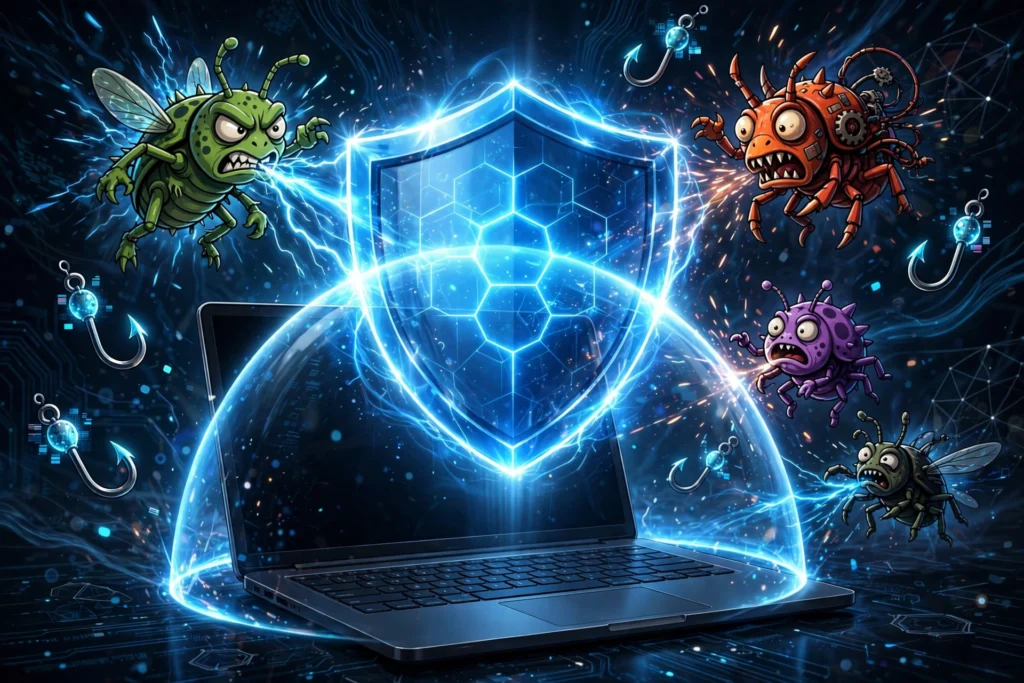
This is the biggest danger. Unofficial streaming sites are a top distribution channel for malware. The threat usually doesn’t come from the video player itself — it comes from everything around it:
- Fake play buttons — Multiple overlapping “play” buttons where only one is real; the others trigger downloads of malicious files disguised as video players or “codecs.”
- Drive-by downloads — Malicious ads that install spyware or ransomware the moment the page loads, sometimes without any click at all.
- Fake software updates — Pop-ups claiming your Flash player or browser is out of date, pushing trojan installers instead.
Once malware lands on your device, it can steal saved passwords, log keystrokes, encrypt your files for ransom, or quietly turn your computer into part of a botnet. Antivirus helps, but it can’t catch everything these sites throw at you.
2. Phishing and Scam Pop-Ups
Clone sites fund themselves with the cheapest, least-regulated advertising on the internet. That means:
- Pop-ups claiming you’ve “won” a prize and asking for personal details
- Fake virus warnings urging you to call a “support” number (a classic tech-support scam)
- Phishing pages that mimic Netflix or bank login screens to harvest credentials
- “Free account” sign-ups that collect your email for spam — or worse
Legitimate streaming services never behave this way. If a site needs pop-up mazes and scare tactics to keep the lights on, that’s your answer about its trustworthiness.
3. Legal Risk
Streaming unlicensed content sits in a legal gray zone that varies by country — but the direction of travel is clear. Rights holders and anti-piracy coalitions like the Alliance for Creativity and Entertainment actively target these networks, and ISPs in many countries (including the UK, US, Australia, and across the EU) send warning notices to users detected accessing pirate sites. Repeated warnings can lead to throttled connections, account action from your ISP, or fines depending on your jurisdiction.
It’s also worth noting the irony: the original 123movies operators shut down under criminal investigation. Using their copycats means trusting your device and data to people operating entirely outside the law.
4. No Privacy Whatsoever
Legitimate services publish privacy policies and answer to regulators. Clone streaming sites answer to nobody. Many run aggressive trackers, fingerprint your browser, and sell behavioral data to whoever pays. Some even inject crypto-miners that silently drain your device’s battery and processing power while you watch. You have no account to delete, no support to contact, and no way to know what’s being collected.
5. Terrible, Unreliable Experience
Even setting safety aside, the experience is poor: links die constantly as domains get seized, video quality is inconsistent (mislabeled “HD” that’s really a camcorder recording), subtitles are broken, and streams buffer endlessly on overloaded servers. Compare that to a free legal service that just works — there’s genuinely no upside left.
Red Flags: How to Spot an Unsafe Streaming Site
Before pressing play anywhere unfamiliar, run through this checklist. If a site hits several of these, close the tab:
- Offers movies still in theaters or released days ago, completely free
- No company name, about page, or contact information anywhere
- Domain changes frequently (.to, .is, .ru, .mx variants of the same brand)
- Multiple fake “play” buttons layered over the video player
- Pop-ups on every click, including new tabs opening without permission
- Prompts to download a “player,” “codec,” or browser extension to watch
- Asks for credit card details for a supposedly free service
- No HTTPS padlock, or a certificate that doesn’t match the site name
What to Do If You Already Used One
Don’t panic — but do act quickly:
- Close the site and don’t download or install anything it offered.
- Run a full antivirus scan with a reputable scanner (Windows Defender, Malwarebytes, or similar) and remove anything it flags.
- Clear your browser data — cookies, cache, and site permissions the page may have set.
- Change passwords for important accounts if you entered any credentials, and enable two-factor authentication.
- Check for unknown browser extensions and remove anything you don’t recognize.
- Monitor bank statements for a few weeks if you entered any payment details.
Safe Legal Alternatives to 123movies
Here’s the good news: you don’t need risky sites to watch movies free. Legal options have never been better:
- Tubi — Tens of thousands of free movies and shows, fully licensed, no sign-up needed.
- Pluto TV — Free live channels plus on-demand movies.
- Amazon Freevee — Free movies and originals built into Amazon’s ecosystem.
- The Roku Channel — Free movies in any browser, no Roku device required.
- Kanopy & Hoopla — Free with most public library cards; excellent for acclaimed films and documentaries.
- YouTube free movies — A rotating selection of ad-supported studio films.
For new releases, digital rentals ($3.99–$5.99) or rotating one subscription at a time costs less than most people spend on coffee in a week. For the full rundown, see our complete guide to watching movies online legally in 2026.
Frequently Asked Questions
Is 123movies safe to use with a VPN?
A VPN hides your IP address, but it does nothing about malware, phishing pop-ups, or scam ads — the main dangers of these sites. A VPN also doesn’t make unlicensed streaming legal. It reduces one risk while leaving the bigger ones untouched.
Is 123movies legal?
No. The original network streamed copyrighted content without licenses and was shut down following a criminal investigation. Its copycats operate the same way. Streaming from unlicensed sources can expose you to ISP warnings or legal action depending on your country.
Can 123movies give my phone a virus?
Yes. Mobile users are actually prime targets — fake “update” prompts and malicious APK-style downloads are common on these sites. Both Android and iOS users have been hit by malware distributed through unofficial streaming pages.
Why does 123movies keep changing domains?
Because its domains keep getting seized or blocked by authorities and ISPs. Constant domain-hopping is itself a red flag: legitimate businesses don’t need to dodge law enforcement to stay online.
What’s the safest free alternative?
Tubi is the closest like-for-like replacement — huge free library, no account required, fully licensed, and available on every major device. Pluto TV and Freevee are strong backups.
Conclusion
So, is 123movies safe? No — and the copycats using its name today are arguably worse than the original. Between malware-laden ads, phishing scams, zero privacy protections, and genuine legal exposure, the risks far outweigh the appeal of “free” movies. Especially when genuinely free, fully legal services like Tubi, Pluto TV, and Freevee offer thousands of films with none of the danger. Make the switch once, and you’ll wonder why you ever risked the pop-up minefield in the first place.
About the Author





1 thought on “Is 123movies Safe? The Honest Answer for 2026”